
Continuous Research Driving A High-Stakes Product Launch
ROLE
UX Researcher
TIMELINE
6 Months (Dec 2024 - May 25)
STUDIES
17 Studies, 200+ Participants
Multi-channel adoption quadrupled, social adoption more than doubled, and trial conversion reached an all-time high
IMPACT
Key Outcomes & Decisions
Contributed to an increase in multi-channel adoption from 7% to 27% by identifying that low usage was driven by a lack of user understanding, not a lack of value
Influenced product direction to prioritize onboarding, guidance, and clarity over additional feature development
Embedded continuous research into a high-stakes product initiative, shaping decisions in real time across 17 studies and 200+ participants
Built stakeholder trust to the point where teams acted on emerging insights before formal reporting, accelerating decision-making
The Situation
Constant Contact's campaign creation experience was built for doing one thing at a time. Users would create an email, send it, and move on, never realizing they could also publish social posts or send SMS from the same platform. Only 7% of campaign creators ever used more than one channel.
The company knew multi-channel users retained better and spent more, but the product wasn't helping anyone get there. So the team set out to reimagine the core creation loop, a project called Multi-Channel Flow (MCF). It became the largest product initiative of the year, with a phased rollout over four months.
How I Worked
MCF moved fast. Research had to match that pace or risk becoming irrelevant to the decisions being made. Over 6 months, I ran 17 studies with 200+ participants, nearly one study per week, using a mix of unmoderated tests, moderated interviews, and rapid iterative concept testing. I was also supporting smaller research efforts across other product areas during this time.
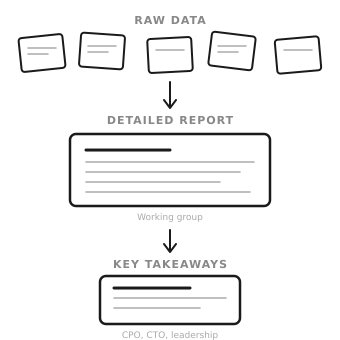
Research was a continuous input, not a phase. For each study, I created a detailed report for the working group and a high-level summary for Thursday leadership syncs with the CPO, CTO, and other senior leaders. Findings fed directly into what the team was building, and in several cases the team started making changes before I'd finished the full report because I was sharing emerging patterns in real time.
Not everyone was sold on research from the start. That shifted as it started catching things the team hadn't anticipated. By the end, many early skeptics were regularly digging into detailed reports and coming to me with questions on their own. Even now, they continue reaching out about research on other topics and reading my reports on product areas outside their own. What started as a project assignment turned into lasting trust and relationships across the org.
Moments Where Research Shaped The Product
There are many studies and specific design decisions I could talk about in detail, but here are a few pivotal moments where research shifted how the team was thinking.

The concept was desirable, but the gap was in understanding
In the first few studies, I kept seeing the same pattern: users were confused by what they were looking at. But the moment I explained the concept, their reaction flipped. They loved it. They saw immediate value in being able to create email, social, and SMS together.
This reframed the project. The team didn't need to convince users that multi-channel was valuable. They needed to help users see it. The designs were strong, but research revealed that users needed more guidance than the UI alone could provide. That shifted the investment from making the feature more powerful to making it more understandable.
Research helped fix the product's vocabulary
Across several studies, I kept hearing terminology confusion. Users were misinterpreting key labels in the interface, guessing they referred to something other than what was intended. Research helped identify these mismatches and test alternatives.
One of the most impactful changes was updating a key label based on what users themselves were saying, which noticeably improved comprehension when tested.
Cumulative findings that streamlined the experience
Not every finding was a pivot. Most were smaller - an interaction that added an unnecessary step, a flow that didn’t behave the way users expected, hierarchy that confused people, etc. Individually, none of these were dramatic. But across 17 studies, they cumulated into a meaningfully better experience.
Research also had an effect beyond the tangible. Sharing clips from sessions, watching real users hesitate, misinterpret, or get excited, built empathy that slide decks alone couldn’t. Over time, stakeholders and senior leadership weren’t just hearing about findings, they were seeing the people behind them, and that changed the quality of the conversations.

Users gravitate toward multi-channel when they experience it
In one study, participants started browsing social media templates on their own, without being prompted. They were naturally drawn to the idea of doing email and social in one place. The interest was organic, but most take the next step of actually adding a second channel.
This told the team something important. Users were curious, but they needed a nudge at the right moment. A prompt or suggestion to try it. This shaped recommendations around onboarding and how the experience could more actively encourage adding a second channel.
The Challenges
The hardest parts of this project were less about the findings and more about the process of delivering continuous research at this pace.

Adapting my research process to meet the timeline
A study per week doesn't leave room for the traditional approach of planning, executing, analyzing, and writing a full report before starting the next one. I had to adapt. For some studies, I created lighter-weight deliverables to keep the turnaround tight. For the Thursday leadership syncs, I distilled complex findings into concise takeaways that landed in a few minutes. The detailed reports came after, for the working group to dig into.
Context switching across the product
MCF had a lot of moving parts: the Channel Manager, the Create Panel, the scheduling experience, onboarding, and the end-to-end flow. In any given week, I might be wrapping up analysis on one component while planning the next study on a completely different part of the product. Staying sharp on the details of each area while keeping sight of how they connected required a lot of intentional organization.

Using AI to move faster
I had just started using AI tools around this time, and I was figuring out how to get the most out of them. I used AI to help analyze session notes and transcripts faster, which was critical at the pace I was running. It was a learning curve on its own, but it made a real difference in how quickly I could identify patterns and turn sessions into insights.
Impact
Research shaped specific design and product decisions throughout the project. The broader impact showed up in the metrics. These numbers are the result of a cross-functional team building and shipping a strong product. Research played a specific role: it ensured the team built the right version of that product. The concept was always strong. Research helped make sure users could actually experience it.
Multi-Channel Adoption
Quadrupled
7% → 27% of customers using 2+ channels
Social Adoption
2X+
More than doubled among email users
Trial Conversion
+10 pts
All-time high by end of year
Monthly Attrition
2 yr low
By end of year